Home » Can you diagnose Tourette Syndrome?
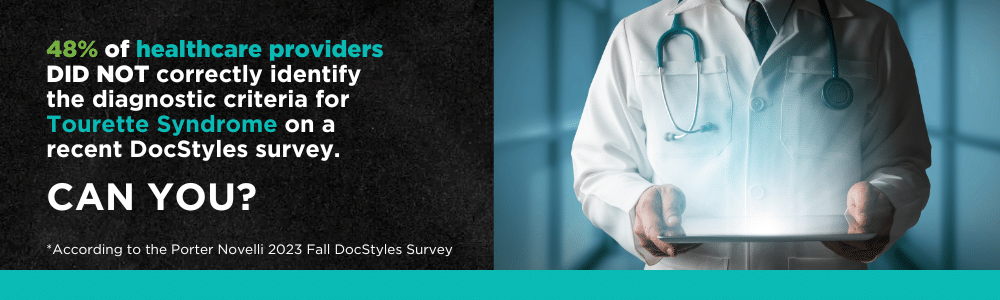
New research from the CDC indicates that approximately 1.4 million people and 1 in 50 children in the United States have Tourette Syndrome (TS) or another persistent Tic Disorder. 50% of these individuals go undiagnosed.
For more than 50 years, the Tourette Association of America has led the way in research and therapeutic development for Tourette Syndrome and other Tic Disorders. This page contains resources for medical practitioners, as created by our subject matter experts, which are intended to equip health care providers with the necessary information to recognize TS and Tic Disorders in their practices so they can provide accurate diagnoses, referrals, recommend appropriate treatments, and guide their patients to the proper avenues for resources and support.
This toolkit is a one stop shop for medical professionals to reference TS and Tic Disorder diagnostic criteria, co-occurring conditions, treatment options (pharmacological and non-pharmacological), scientific articles on the subject, support and resources, and more. The toolkit also includes a sample doctor’s letter and information about addressing your patient’s needs in the classroom.
Tourette Syndrome is a neurodevelopmental disorder that affects children, adolescents and adults. The condition is characterized by sudden, involuntary movements and/or sounds called tics. Tics can range from mild/inconsequential to moderate and severe, and are disabling in some cases.
Tourette Syndrome is one type of Tic Disorder. Tics are the primary symptoms of a group of childhood-onset neurological conditions known collectively as Tic Disorders and individually as Tourette Syndrome (TS), Persistent (Chronic) Motor or Vocal Tic Disorder, and Provisional Tic Disorder. These three Tic Disorders are named based on the types of tics present (motor, vocal/phonic, or both) and by the length of time that the tics have been present.
Below are the criteria that a doctor or other health care professional will use to diagnose TS or other Tic Disorders. There is no test to confirm the diagnosis of Tic Disorders, but in some cases, tests may be necessary to rule out other conditions.
Tourette Syndrome (TS), also known as Tourette’s Disorder: 1) At least 2 motor tics and at least 1 vocal (phonic) tic have been present, not necessarily at the same time. 2) Tics may wax and wane in frequency but have occurred for more than 1 year. 3) Tics started to appear before the age of 18. 4) Tics are not caused by the use of a substance or other medical condition.
Persistent (Chronic) Motor or Vocal Tic Disorder: Either motor tics OR vocal tics have been present for more than 1 year; cannot be both motor and vocal tics.
Provisional Tic Disorder: Motor and/or vocal tics have been present for less than 1 year, and have not met the criteria for TS, persistent (chronic) motor, or vocal tic disorder.
Motor tics are movements. Simple motor tics include but are not limited to: eye blinking, facial grimacing, jaw movements, head bobbing/jerking, shoulder shrugging, neck stretching, and arm jerking. Complex motor tics involve multiple muscle groups or combinations of movements and tend to be slower and more purposeful in appearance,(e.g., hopping, twirling, jumping).
Vocal (phonic) tics produce a sound. Simple vocal tics include but are not limited to sniffing, throat clearing, grunting, hooting, and shouting. Complex vocal tics are words or phrases that may or may not be recognizable but that consistently occur out of context. In 10-15% of cases, the words may be inappropriate (i.e., swear words, ethnic slurs, or other socially unacceptable words or phrases). This type of vocal tic, called coprolalia, is often portrayed or mocked in the media as a common symptom of TS.
Tics typically emerge between the ages of 5 and 7 years, usually with a motor tic in the head or neck region. They tend to increase in frequency and severity between the ages of 8 and 12 years and can range from mild to severe. Most people with TS see improvements by late adolescence, with some becoming tic-free. A minority of people with TS continue to have persistent, severe tics into adulthood.
Tics can range from mild to severe and, in some cases, can be self-injurious and debilitating. Tics regularly change in type, frequency, and severity—sometimes for reasons unknown and sometimes in response to specific internal and external factors, including stress, anxiety, excitement, fatigue, and illness.
Tics occur in as many as 1 in 5 school-aged children, but may not persist. TS and other Tic Disorders combined are estimated to occur in more than 1 in 50 school-aged children in the United States. TS occurs in 1 in 160 (0.6%) school-aged children, although it is estimated that 50% are going undiagnosed. The reported prevalence for those who have been diagnosed with Tourette is lower than the true number, most likely because tics often go unrecognized. TS affects all races, ethnic groups and ages, but is 3-4 times more common in boys than in girls. There are no reliable prevalence estimates of TS and other Tic Disorders in adults. However, they are expected to be much lower than in children as tics tend to decline into late adolescence.
The causes of TS and other Tic Disorders remain unknown. These conditions tend to occur in families, and numerous studies have confirmed that genetics are involved. Environmental, developmental, or other factors may also contribute to these disorders but, at present, no specific agent or event has been identified. Researchers are continuing to search for the genes and other factors underlying the development of Tic Disorders.
People with TS often have other mental, behavioral, or developmental conditions that may be present prior to the onset of tics. While tics are the primary symptoms, these co-occurring conditions may cause more problems and can be more bothersome than the tics themselves.
Among people diagnosed with TS, it is estimated that 86% have been diagnosed with at least one of these additional conditions. The most common co-occurring conditions include the following:
Deep Brain Stimulation (DBS) is a potential treatment for certain Tourette Syndrome (TS) patients with severe motor or vocal tics affecting their quality of life, despite other treatments. While there’s significant media interest in DBS for TS, it raises many questions. We aim to address these and provide an update on its current state.
Managing TS: A Guide to Treatment for Care Providers
Living with TS: A Guide for Patients and Families
What is TS?
What is CBIT?
I have TS Card
The Tourette Association of America’s Centers of Excellence (CofE) program recognizes medical institutions that offer the highest level of care, are undertaking groundbreaking research, are leaders in training and education, and provide exceptional community outreach and advocacy for TS and other Tic Disorders. For more information or to become a CofE, click the Learn More button below.
The TAA supports clinical research and clinical studies to improve the quality of life for those affected by Tourette Syndrome. The studies below are listed for informational purposes only.
Visit www.clinicaltrials.gov for a more comprehensive list of opportunities to participate in research studies in your area.
Our Education Advisory Board (EAB) works hand-in-hand with our staff to provide valuable insights into the experiences of our community’s students, their caregivers, and the educators, administrators, and counselors who support them. Through the EAB’s efforts, the TAA is able to ensure our programs, resources, and individualized support aligns with the needs of our community.
Are you interested in getting involved with the TAA and receiving the latest news regarding Tourette Syndrome and Tic Disorders? Tell us about your specific interests and we’ll be in touch.